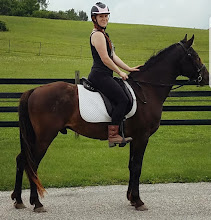
The mud fever is clearing up pretty well. Most, if not all, of the scabs are gone. I've done my little "treatment plan" twice now. The foot hasn't been hot or swollen since the first time I did it. Honestly, I don't really know what to look for.. but, so far so good I guess. I haven't worked with Bones a whole ton and it's showing. He seems to be hotter than usual. I got on him bareback last week and trotted him a little bit. He crow hopped! Naughty little Arabian! So, I decided to saddle him up and do some trotting work and work him through the crow hops. He did maybe 3-4 more under saddle, nothing big.. just kicked up his back legs (I hope crow hop is the right term?). I ended up cantering him a little bit again. He's developing a very good "whoa". He even does a dead stop after a canter! =| Haha. That's definitely something we are going to work on. At least I expect it now.. the first time he did it I was completely thrown off balance. Last night I got on him bareback again and just did some walking around the arena. We did lots of stops and backs. He is actually getting good at his back, too. The dentist is coming out this evening. I'll try to get some pics but, I don't know if she (the dentist) would like me to.. hm, I'll have to see. I'll get some pics of the mud fever foot too.
I've been trying to identify Bones. I posted on ABN
hoping someone may recognize him or be able to look him up on Data Source. But, no luck. I would seriously love to know who Bones is but, I may just have to except I'll never know his history. I've lost contact with the rescue I got him from (they won't answer my e-mails after asking for more info on him). They didn't tell me anything about where he came from other than it was a "rescue" that starved him. I don't know if he was bred in Ohio, or even if the "rescue" they got him from was in Ohio. It's frustrating trying to identify him with little to no information and the rescue I got him from isn't willing to help.


What "treatment plan" have you been using with the mud fever? My pastures are crazy this year and I thought I felt little scabby bumps under my mares front pasterns last night... If its not one thing its another! lol Hope you have some luck finding more info on bones, that would be awesome to find out where he originally came from... Im gonna pray real hard that you get some responses to the ABN post! :)
ReplyDelete1- Soak foot in warm water (with or without epsom salt) to loosen the scabs
ReplyDelete2- Gently rub off any scabs that will come off easily. The scabs are very painful for the horse, she'll tell you if your picking scabs that aren't ready to go yet.
3- Use Hibiclens (I got it from CVS) to clean the area
4- Rinse thoroughly
5- Gently dry with a towel, let air dry for a few minutes
6- Put baby diaper cream all over the scabs/area where the scabs were
I've read/heard sooo many different ways to cure mud fever. My farrier suggested mixing iodine with brown sugar and putting it on the foot. I guess it will loosen the scabs to make it easier to take them off. This darn rescue horses always coming up with new ways to trouble us! Just kidding, of course. =)
I found this on Yahoo Answers. It seems to make sense and is published by a RN that posts under "Gallop"
ReplyDeleteWell, first of all, don't keep brushing her legs. You are just spreading the infection over a broader area and may drive it deeper into the skin so it can spread there. If that happens, you will need systemic antibiotics to cure it.
Also, you should never bandage or boot over this infection. If it occurs on your horse's back, as rain rot, you should not blanket over it either. You want as much exposure to air and UV light as possible to kill these bacteria.
This is a bacterial infection. The bacteria called dermatophilus congolensis live in the skin and damp, dark conditions allow the bacteria to thrive, since they are anaerobic (survive in the absence of oxygen). This infection is spread from one horse to another, and can infect humans. The bacteria are not found in the soil, but live dormant in the horse's skin until the skin integrity is disrupted by injury or very wet conditions, allowing the bacteria to multiply. You can spread it from one horse to another on grooming tools, etc.
I soak the scabs with 0.9% saline you can get from your local drugstore. When the scabs loosen, I use cotton pads to remove them thoroughly, and rinse the sores beneath with saline again, then dry them completely. The salt in the saline dehydrates and kills the bacteria, and saline is balanced with the body fluids so it won't irritate or harm healthy tissue. You can also add a cleansing with Hibiscrub (Hibicleanser), and rinse it well with the saline before thoroughly drying the sores.
Getting the scabs off, and the sores dry, is the most important thing to do with this infection.
Leave the sore open to air. Air and UV light from the sun kill these bacteria, so leaving the sores exposed is best.
But, if you can't get the horse out of the mud, or if insects will be landing on the sores, then you can apply a thin layer of EMT ointment to protect them and heal them rapidly. It is a collagen gel, and it adheres very well. You can get it at tractor or farm supply stores, or online. It is the best oinment I've used for this and other lesions, and for wounds. It will also block pain and itching while preventing infection and speeding healing.
So, you need saline (0.9%), Hibiscrub, and cotton balls or pads from the drugstore, and EMT ointment from the farm supply store if needed to protect the sores.
Be sure the sores are dried completely, especially if you are going to apply the ointment. Any ointment applied over damp skin will allow the bacteria to multiply beneath.
Unless the infection has already spread into deeper tissues and caused a cellulitis, this treatment works to eradicate the infection within a day or two. If there is swelling under the skin and significant pain, you may need systemic antibiotics from your vet. Since secondary infections with bacteria like more resistant strains of staph or strep may occur, it is important to treat this as efficiently and rapidly as possible.
Sometimes it's best to get the horse on systemic antibiotics right away to get the infection under control.
Thanks! Im definitely going to cvs tomorrow and give it a try. Im not sure its mud fever but Im not doing to take any chances on it spreading. (I googled for pics and saw the bad cases you were talking about...YIKES!!!)
ReplyDelete